On the Orthogonality of Provably-Fair RNG and Solver-Bot Mitigation
Summary: Provable fairness solves game integrity — it cryptographically proves the operator did not rig the deal. It does not solve player integrity — whether your opponents are humans or solver-driven bots. The two are independent. A verifiable shuffle and a bot-infested table can coexist perfectly, because a bot automates the decision taken on fairly-dealt cards, never the cards themselves.
The proposition that a provably-fair shuffle obviates concern about automated opponents is empirically common and formally incorrect. This document formalises the orthogonality of the two guarantees: the cryptographic commitment binds the operator with respect to deal integrity, while the population of decision policies executed by an opposing seat is unconstrained by that binding. The two questions are addressed by disjoint mechanisms and must be evaluated independently.
What “provably fair” actually proves
Provable fairness is a commit-reveal protocol layered over the deal. The structure is consistent across crypto-gaming platforms, CoinPoker included:
- Before the hand, the server generates a secret server seed and publishes only its hash — a binding commitment. It cannot change the seed later without the hash mismatching.
- The player (or client) contributes a client seed. Mixing it in means the operator cannot have precomputed the entire deal in its favor.
- A nonce or hand counter increments per hand so identical seeds don't reproduce identical shuffles.
- After the hand, the server reveals the server seed. Anyone can hash it (confirming it matches the earlier commitment) and re-run the shuffle algorithm with both seeds to verify the exact card order.
If the recomputed order matches what was dealt, the deal is proven honest. If it doesn't, the operator is caught immediately and publicly. This is a strong, elegant guarantee. It eliminates an entire category of operator fraud — stacked decks, mid-hand reshuffles, dealing the house a flush. For that specific threat, it is close to airtight.
Mechanically, the verification is something a player can do without trusting anyone. A typical check, expressed in pseudo-form:
given:  serverSeed (revealed), clientSeed, nonce, commitment
1.  assert  hash(serverSeed) == commitment      # seed wasn't swapped
2.  stream = HMAC(serverSeed, clientSeed + ":" + nonce)
3.  deck   = fisher_yates(stream)               # deterministic shuffle
4.  assert  deck == cards_as_dealt              # deal wasn't altered
If steps 1 and 4 both pass, the operator is provably honest for that hand — no trust required, no appeal to reputation. This is genuinely powerful, and it is the property crypto-poker marketing leans on. The trouble starts when that property gets stretched to cover a problem it was never designed for.
The false-security trap
The cognitive error is a substitution. A player hears “provably fair,” mentally translates it to “safe,” and stops asking the harder question about who they're actually playing against. “Fair” in this context is a precise, narrow, cryptographic claim about the shuffle. “Safe from bots” is a broad behavioral claim about the field. They share a word in marketing copy and nothing else in reality. The danger is that the proof is so visibly rigorous it lends unearned confidence to the part it doesn't cover — players relax exactly where they should stay alert.
The boundary: game integrity, not player integrity
Here is the precise limit. Provable fairness makes a statement about the cards and the operator. It says: the deck was shuffled by the agreed algorithm and not tampered with. It makes no statement whatsoever about the players — who they are, how they decided, or what software helped them.
Think of it as two separate ledgers:
| Question | Answered by provable fairness? | Belongs to |
|---|---|---|
| Were the cards dealt honestly? | Yes — verifiable on-chain | Game integrity |
| Did the house cheat the RNG? | Yes — caught by the hash | Game integrity |
| Is my opponent a human? | No — out of scope | Player integrity |
| Did a solver choose that bet? | No — out of scope | Player integrity |
| Is one person multi-tabling 12 seats? | No — out of scope | Player integrity |
Every row in the bottom half is invisible to the cryptography. The proof confirms the deck; it cannot read the mind — or the script — of the person acting on the deck. That is the whole gap.
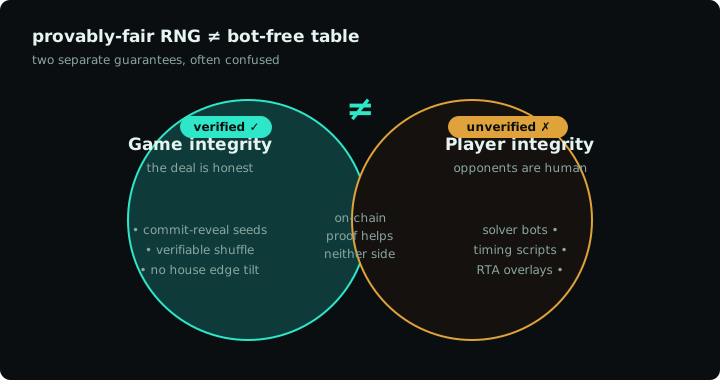
Why a solver bot is invisible to the shuffle proof
A solver bot never interacts with the RNG. Its loop is mundane:
read table state  (stacks, board, pot, position)
    → feed to solver  (precomputed strategy or live solve)
    → receive action  (fold / call / raise X)
    → click it on the client
Nothing in that loop reads, alters, or even cares about the server seed. The bot receives the same fairly-dealt cards a human would and simply decides better and faster. From the verification system's point of view, the hand is flawless — the deck checks out — even though one seat was played by a machine. The shuffle proof and the bot are operating in entirely different layers of the stack, and neither can see the other.
Provable fairness answers “can I trust the dealer?” A bot exploits the unanswered question: “can I trust the other players?”
It is worth being concrete about what the bot does and does not gain from a provably-fair site. It does not gain card knowledge — the deal is as random to the bot as to everyone else, and the proof would expose any tampering. What it gains is the same thing it gains anywhere: a tireless, mathematically-disciplined decision engine playing against humans who tire, tilt, and misremember ranges. Provability neither helps nor hinders that edge. The shuffle being verifiable is simply irrelevant to a solver that only cares about acting optimally on whatever it was dealt.
A common objection: “but everything is on-chain”
People reasonably assume that if hands are recorded on a public, verifiable ledger, bots should be easy to spot — surely the transparency catches them? The transparency is real, but it is transparency about the cards and seeds, not about the identity or software of the player. The chain records that seat 4 raised to 2.5bb on a fairly-dealt board. It does not record whether a human or a script chose that raise. To answer that, you have to leave the cryptographic layer entirely and model behavior — and behavior is not something a hash can attest to. The ledger tells you what happened with perfect fidelity; it is silent on who or what made it happen.
Does an on-chain layer make detection easier?
Slightly — but not in the way people expect. Because hands and seeds are recorded and verifiable, the resulting hand-history dataset is clean and tamper-evident. That is a good substrate for the behavioral analysis detection actually relies on: you can trust that the recorded actions and timings are real, which makes statistical anomaly detection more reliable. But the on-chain layer supplies the data's integrity, not the verdict. The verdict still comes from modeling player behavior — timing distributions, bet-sizing entropy, multi-tabling patterns — exactly as it does on a non-crypto site. The cryptography hands you trustworthy evidence; it does not tell you who is a bot.
Where the two layers genuinely interact
To be fair to the technology, there is one place the cryptographic and behavioral layers touch, and it is worth stating precisely so it isn't overclaimed. Behavioral detection is only as good as the data it runs on. On a conventional room, you trust the operator's recorded hand histories; if those records were ever quietly edited, the statistics built on them would be corrupted at the source. On a provably-fair site, the deal — and by extension the recorded sequence of cards and actions tied to verifiable seeds — is tamper-evident. That doesn't identify a single bot, but it raises the trustworthiness of the substrate the detection model consumes.
So the correct claim is narrow: provable fairness improves the integrity of the evidence available to behavioral analysis. It does not improve the analysis, and it certainly does not replace it. A site could publish flawless on-chain proofs for every hand and still have done zero behavioral monitoring, leaving the field full of undetected solvers. The proof and the policing are independent investments; one being present tells you nothing about the other.
How to read “provably fair” claims
When you encounter a crypto-poker room advertising provable fairness, parse it literally and resist the upsell. The claim means: you can verify our shuffle. Useful. It does not mean: our tables are bot-free, our field is all-human, or your opponents are honest in the behavioral sense. If a room implies the latter from the former, that is marketing, not cryptography. Ask the separate question — what behavioral detection do they run, how is it staffed, what is their action rate on confirmed automation? — because that, not the shuffle proof, is what determines whether the seat next to you is a person.
The practical takeaway
Treat the two guarantees as separate purchases. Provable fairness is worth having and CoinPoker-style verification delivers it well — you no longer have to trust the house's shuffle. But it buys you exactly zero protection against the player across the table running a solver. Anyone marketing “provably fair” as an anti-bot feature is conflating two unrelated problems. For the bot problem, the relevant question is not “can I verify the deal?” but “what behavioral signals separate a human from a script?” — which is the subject of the companion note on detection signals.

Writes about poker automation, game-integrity systems, and how detection actually works in practice — separating the cryptography from the behavioral side.