This study examines two questions that are routinely conflated in discussion of CoinPoker. Game integrity, the property guaranteed by provably-fair commit-reveal RNG, concerns whether the cards were dealt honestly by the operator; this question is resolved cryptographically. Player integrity, the property concerning whether the opposing seat is operated by a human or by an automated decision policy, is shown to be orthogonal to the first and is addressed only through behavioural classification.
Short answer: Provably-fair RNG proves the deal is honest — that the cards were not rigged by the house. It says nothing about whether the player across the table is a human or a solver bot. Game integrity and player integrity are two separate problems, and only the first one is solved cryptographically. A “CoinPoker bot,” in practice, is software that automates decisions (when to fold, how much to bet) — not the cards. Detecting it is a behavioral problem, not a cryptographic one. If you want a straight read on what's actually feasible on CoinPoker, the closing note below has a way to ask.
How crypto poker is different — and how it isn't
A conventional online poker room asks you to trust its shuffle. You cannot inspect the RNG; you take the operator's word that the deal was fair. Crypto-poker sites like CoinPoker remove that trust requirement with a commit-reveal scheme: before a hand, the server publishes a hashed commitment to its seed; you contribute a client seed; after the hand, the server reveals its seed and anyone can recompute the shuffle and confirm it was never altered mid-hand.
This is a meaningful upgrade for one specific threat — a dishonest house. It closes the “the site is dealing itself good cards” attack almost completely. What it does not touch is everything happening on the player side: the decisions other humans (or programs pretending to be humans) make with the cards they were fairly dealt.
What a bot actually automates: decisions, not the deal
This is the core confusion the term “CoinPoker bot” creates. People imagine software that rigs the cards. That is not what a poker bot does, and on a provably-fair site it could not — the math would catch it. A real automation tool sits entirely on the player's side and automates the policy:
- Decision-making. A solver computes a near-optimal action for the current spot and the bot clicks it — fold, call, or a specific bet size.
- Table reading. Screen-scraping or API access converts the table state (stacks, board, pot) into the solver's input.
- Multi-tabling. One operator runs many tables at once, far past what a human can attend to.
- Timing. The bot acts on its own clock — which, ironically, is one of the easiest things to catch.
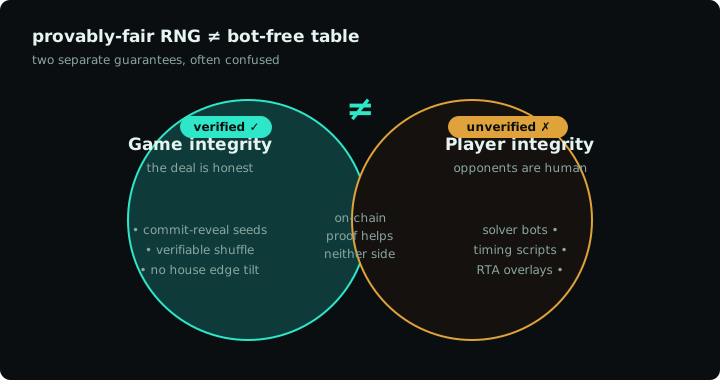
Notice none of that requires touching the RNG. The deal can be perfectly, verifiably fair and the table can still be full of bots. Provable fairness and a bot-free table are orthogonal guarantees — the diagram below makes the split explicit.
How crypto-poker sites approach detection
Because the cryptography cannot help here, rooms fall back on the same toolkit every poker operator uses — applied to player behavior, not the deal:
- Timing analysis. Humans have noisy, context-dependent reaction times; scripts tend to cluster. The shape of a player's time-to-act distribution is one of the strongest tells.
- Bet-sizing entropy. Solvers produce suspiciously precise, repeatable sizings; humans are messier.
- Session and client signals. Multi-accounting, identical hardware fingerprints, and headless-client artifacts.
- Network review. Hand histories flagged by the automated layer get human eyes before any action is taken.
The important point is that none of these signals comes from the chain. They come from watching how a seat behaves over many hands. A provably-fair record actually helps here in one narrow way: because the hand histories are tamper-evident, the data feeding that behavioral analysis is verifiably real, which makes the statistics more trustworthy. But the cryptography supplies clean evidence — it does not deliver the verdict.
The four terms worth knowing
If you only take four definitions away from crypto poker, take these. They are what “provably fair” is actually built from:
- Provably fair
- A scheme that lets any player independently verify a game outcome was produced by the agreed procedure and not altered by the operator.
- Commit-reveal
- A two-phase protocol: first publish a hash commitment to a secret, then reveal the secret so others confirm it was fixed in advance.
- Client seed
- A random value the player supplies into the shuffle, so the operator cannot fully predetermine the deal.
- Server seed
- The operator's secret value, committed by hash before the hand and revealed afterward for verification.
So — is a CoinPoker bot real?
Software that automates poker decisions exists, and it works on any online room regardless of whether the deal is provably fair, because it never touches the deal. What does not exist is a bot that beats the cryptography — on a provably-fair site, rigging the cards is the one thing the math makes impossible to hide. So the honest framing is: the “cheat” people imagine (rigged cards) is the part crypto poker has actually closed; the real risk (an automated opponent making better decisions than you) is the part it leaves wide open. Knowing which is which is the whole point of this site.
If you want the mechanics in depth, the two practitioner log below go further: one on why provable fairness does not stop solver bots, and one on the behavioral signals detection systems actually look at.
Bottom line: this is a hard, fast-moving problem, and what gets advertised around “CoinPoker bots” rarely matches what is actually feasible against a provably-fair room with behavioral detection. If you want a straight answer on what's realistic on CoinPoker specifically — and what isn't — talk to our team. No pitch.
This is independent research and reference material. It is not affiliated with, endorsed by, or operated by CoinPoker, and “CoinPoker” is used here only to name the platform under discussion.